Winner of the Jean Fanchette Prize 2021
Fifteen-year-old Noemi has no choice but to leave school and work in the house of the wealthy De Grandbourg family. Just across the road from the slums where she grew up, she encounters a world that is starkly different from her own – yet one which would have been all too familiar to her ancestors. Bewitched by a pair of green eyes and haunted by echoes, her life begins to mirror those of girls who have gone before her.
Within Noemi’s lament is also the herstory of Mauritius; the story of women who have resisted arrest, of teachers who care for their poorest pupils and encourage them to challenge traditional narratives, of a flawed Paradise undergoing slow but unstoppable change.
In Riambel, Priya Hein invites us to protest, to rail against longstanding structures of class and ethnicity. She shows us a world of natural enchantment contrasted with violence and the abuse of power. This seemingly simple tale of servitude, seduction and abandonment blisters with a fierce sense of injustice.
Praise
‘With Riambel, Priya Hein has given us a book that should be essential reading for all those who care about our history, in particular the devastating legacy of slavery; but what is extraordinary is that she tells this harrowing story in the most beautiful prose, luminous and musical, drawing in the reader before hitting them hard with the reality of her young narrator’s life, and the humiliations and pain she endures because of this very legacy. Today more than ever, this story needs to be told; Priya Hein does so movingly and powerfully.’
—Ananda Devi, author of Eve Out of Her Ruins
‘Modern and edgy . . . rich in smells, sounds and feelings.’
—Süddeutsche Zeitung
‘Riambel bravely grasps the complexity of ethnic relationships in Mauritius . . . displaying great art in the sense of shame blended with indignation and in the gaps in what is not said.’
—J. M. G. Le Clézio, winner of the Nobel Prize for Literature
‘A stunning book which cradles the anger of generational slavery experienced by Mauritians . . . thank you Priya for sharing our history with the world.’
—Shelina Permalloo, Restaurateur, Food Writer and TV Chef
‘Priya Hein’s novel is spell-binding. Riambel is beautiful. It is terse and yet lyrical. It is tough, and yet bursting with life.’
—Lindsey Collen, author of The Rape of Sita and Getting Rid of it
‘In the span of a mere 160 pages, this extraordinary debut packs rare insight into the trauma and deference seeded by the long reign of capitalism and the white man’s whims.’
—Vartika Rastogi for The Cardiff Review
‘I was astounded by the blistering prose and originality in Priya Hein’s stunning debut Riambel . . . Against the backdrop of uncomfortable and, at times, disturbing fragments depicting abuse, rape and exploitation, I loved the way the richness of the local Mauritians’ culture is depicted: through culinary recipes, oral history, poetry and songs woven beautifully into the narrative. It’s a slim novel but one that punches deeply and screams aloud. It invites us to oppose the injustice of the longstanding structures of class, hostility and white capitalism.’
—Nataliya Deleva, author of Four Minutes and Arrival
‘Beautiful, powerful prose supporting an important story. I’ll be haunted by the mother and her two daughters from Riambel for years to come. Please treat yourself to this pithy novel.’
—Zeba Talkhani, author of My Past is a Foreign Country and The Most Exciting Eid
‘On the inhale it is rich with the beauty of her world, the ugliness of the divide between rich and poor; on the exhale it is musical, powerful, and bitterly melancholic.’
—Ruth McKee, for the Irish Times
‘Not just a brilliant addition to contemporary Mauritian literature, but to literature, period. I’m feeling the book’s themes of power, ethnicity, and colonial legacy – then and now – alongside its cold rage, vulnerability and utter strength deeply. It truly sings.’
—Niven Govinden, author of Diary of a Film
‘Riambel is an illuminating exploration of the violent history of slavery and the ways it continues to dictate and devastate Mauritian lives.’
—Yagnishsing Dawoor, for the TLS
‘A gripping, sensitive, honest story, whose timelessness should give us pause.’
—Alice Hasters
About the author
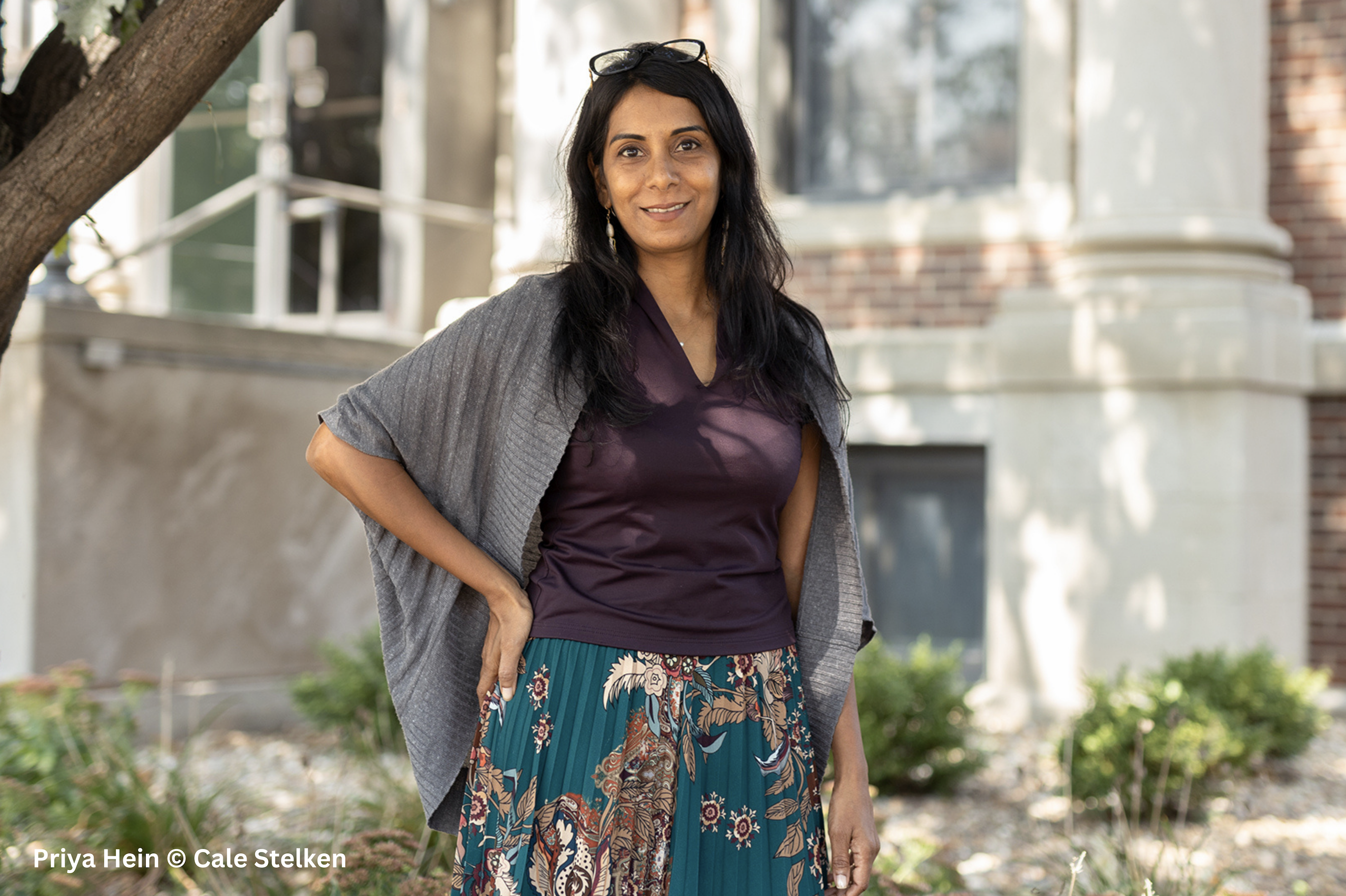
Priya Hein is a Mauritian author whose first novel Riambel won the Prix Athéna 2023 and The Jean-Fanchette Prize 2021. She was nominated for the 2017 Astrid Lindgren Memorial Award, shortlisted for the Prix de l’Atelier Littéraire in 2021 and the Miles Morland Scholarship in 2023, and participated in the 2024 Iowa IWP fall residency. Priya lives in Mauritius with her family.
Un truc, machin, quelquepart: learning to love the literatures of Mauritius
Susie Nicklin
It’s embarrassing to admit one’s ignorance, especially after a lifetime of reading and travel. But, I realised, shortly after acquiring the world English rights to Riambel, by Priya Hein, from Anna Soler-Pont of the Pontas Agency, a novel whose title refers to a village set on the southernmost tip of Mauritius, I knew almost nothing about this island in the Indian Ocean.
The short quote from Mark Twain about it being a paradise, which kept flashing up on the BA entertainment system throughout a twelve-hour flight, wasn’t much help. My only consolation was that I suspected most of the British travellers on the packed flight from Gatwick were similarly uninformed.
I spent the morning after my arrival on the beach reading Philippe Sands’ magisterial The Last Colony, a history of the British government’s relationship with the Chagos Islands and the legal struggles for the right to return of those who suffered forced exile from their homes. Sands mentions that, unusually, a novel was referred to in the Hague, where the case was heard; that novel is Diego Garcia by Luke Williams and Natasha Soobramanien, next up on my Kindle. In an even more meta development, Soobramanien name checks many Mauritian writers in her novel, most of whom I met during a wonderful week, some that very evening.
Ananda Devi, Lindsey Collen, Shenaz Patel, Barlen Pyamootoo, and Caroline Laurent, all came to the literary festival at Trou D’Eau Douce, (TDD for short) the focal point of my visit.
But before then, there was a lot to be done. A trip down to Riambel itself, a small village bisected by a main road; on one side the beachfront houses of the rich, on the other the shanty town or ‘site’ (pronounced like cité), regularly destroyed during cyclones, patched up and demolished again in an endless cycle of renewal.
This is the setting of Priya’s novel, published in French by Globe Editions, forthcoming from Indigo in February 2023 with rights also sold in Catalan. It is the tale of Noemi, a girl from the slums who is forced to leave school at fifteen to work for the De Grandbourg family and who is seduced and abandoned by a scion of the Franco-Mauritian haute-bourgeoisie. Interlaced with the haunting voices of long-dead slaves, poems, songs and recipes, it is, like Diego Garcia, (and like Arrival by Nataliya Deleva which we published in February 2022) a novel in fragments, testimony to the splintering effects that trauma has on one’s psyche and ability to frame a coherent narrative.
On the way down to Riambel from the upscale area of Rivière Noire we visited the international slave route monument within Le Morne Cultural Landscape, part of the UNESCO World Heritage Site of Le Morne Mountain. This is the forbidding 555m high volcanic outcropping from which runaway or ‘marron’ (derived from a Portuguese word) slaves jumped to their deaths rather than be recaptured by British troops.
It is a solemn commemoration of a shameful and violent imperial drive which was replicated around the globe. I urge all readers to seek out a detailed history of the island, but briefly, it was first colonised by the Dutch from 1638 – 1710, by the French from 1715 to 1810 and by the British from 1810 – 1968 (they allowed the population to keep their languages and religion); it is still part of the British Commonwealth, notwithstanding the appalling Chagos Islands affair.
It is possibly the most heterogeneous country I’ve visited. There are the white French families, about twenty of whom make up the élite tier who formerly controlled sugar production (which includes the Le Clézio clan of the Nobel Prize-winning writer and Philippe Rey of the eponymous Parisian publishing house); a handful of white British families who were part of the colonial administration; the descendants of former slaves brought here from around the world; and hundreds of thousands of families brought here by the British from India to be indentured labourers following the abolition of slavery in 1835. There are also many Chinese families, some of whom were brought in by the British to run small businesses such as ‘quincailleries’ [hardware shops]. There are also South Africans, Russians, expats from around the world, emigrant Mauritians returning to run important sectors such as banking. And 17 per cent of the population is Muslim, the muezzin echoing around towns and villages.
The main industry apart from tourism remains sugar, with cane growing all over the island. It is now harvested mainly by machine, and exported in many guises including molasses, syrup and rum, with the by-products used to create electricity (although this is not a particularly sustainable economy, catering for tourists who demand nonstop services including multiple verdant golf courses). The main languages are French and English, so I thought I’d be at home linguistically, only to realise that Creole has a firm place here, as a spoken language if not so frequently a written one (although the opening ceremony of the festival featured a bravura performance by Yusuf Kadel from his Creole poetry collection Lavi Wilson Bégué).
It’s a form of resistance, this demotic speech which I can puzzle out if I see it written down and laboriously articulate it but which eludes me aurally. Everywhere I went it was the basis of transactions, decisions, discussions. Trying to check out of a hotel, in which the front desk staff had been trained to supply rote answers to questions I wasn’t asking, the whole dynamics changed when they discussed the problem amongst themselves, body language and hand gestures showing an engagement which the formal English and French responses couldn’t convey. Whether buying Sunday lunch at the local favourite restaurant Les Alizés in Trou D’Eau Douce (the name means fresh waterhole), enjoying spontaneous audience encounters at the festival, buying fresh fish at the ocean’s edge of our borrowed beach house, or trying to order on the grand veranda of Le Domaine des Aubineaux, an Edwardian villa of the kind featured in Riambel, Priya, a native of Mauritius who has also lived in Britain, Belgium, France and Germany, needed her Creole to communicate, as it is the lingua franca of the island’s 1.3 million inhabitants.
Barlen Pyamootoo, a native of TDD and a francophone author and film maker published by Editions de l’Olivier in Paris, recognises that most inhabitants of this small village of his age are illiterate, so he brought together spoken word, music, conversation and radio, in addition to bookstalls and workshops, to inspire his community – more about that here.
France was the guest country in this the festival’s second year, so the Institut Français de Maurice, in its exceptionally beautiful building in Rose Hill, open to the elements, draped in vines and enclosing trees and other native plants, with an amphitheatre and lecture rooms in addition to a library, café and atrium, was the setting for a professional day before the official inauguration & evening concert, attended by many local publishers and writers as well as international guests like me.
During the course of the weekend various dignitaries including the President and Vice-President of Mauritius, the French Ambassador and a delegation from the island of Réunion made an appearance; on the day before the events at the IFM, the French Cultural Centre in Curepipe hosted the writer Michèle Rakotoson from Madagascar, in a lively exchange with her publisher Corinne Fleury and writer Shenaz Patel; the latter berated the Vice President to his face about the lack of access to national archives granted to Mauritian journalists.
An exhibition devoted to the twentieth-century Mauritian writer Malcolm de Chazal brought together other past literary heroes including the British Robert-Edward Hart, OBE, whose spartan house in Souillac close to Riambel includes displays of his writing and whose poetry features in Priya’s novel.
In the end, for me but perhaps also for all Mauritians, language is an essential route through to some understanding of this complex nation, created within my lifetime. (The title of this piece comes from a festival volunteer’s throwaway remark about a putative event – rough translation: ‘a thing, sort of, somewhere’.) Since most citizens easily speak at least three, it makes sense that it has produced world class writers and publishers, and that others, especially francophone, were eager to visit. The Senegalese winner of the Prix Goncourt for 2021, Mohammed Mboughar Sarr, spoke with eloquence and generosity (and without notes) in his keynote address, name checking many of the Mauritian writers present as if they were already friends, which they probably were.
As a small country it is unsurprising that the literati know each other well, but the mutual support systems are tangible and rewarding, and Priya was overjoyed by the level of endorsement that the leading francophones have given so far to a neophyte anglophone novelist. It was cause of some sagren for me (sagren = a loose approximation of chagrin, it’s the word the Chagos Islanders use for a mournful/desperate feeling about their loss) that the English language publishing and bookselling world wasn’t much in evidence, but it is possible that a newer generation of digitally-connected readers will want more English books. And maybe some of those tourists could be persuaded out of their gated complexes to learn about this exceptional place and to read its literature, starting with Riambel.